

Senior Partner
Stritmatter Law recently filed another lawsuit against Amazon over a lithium-ion power bank fire. All such cases involve serious burn injuries.
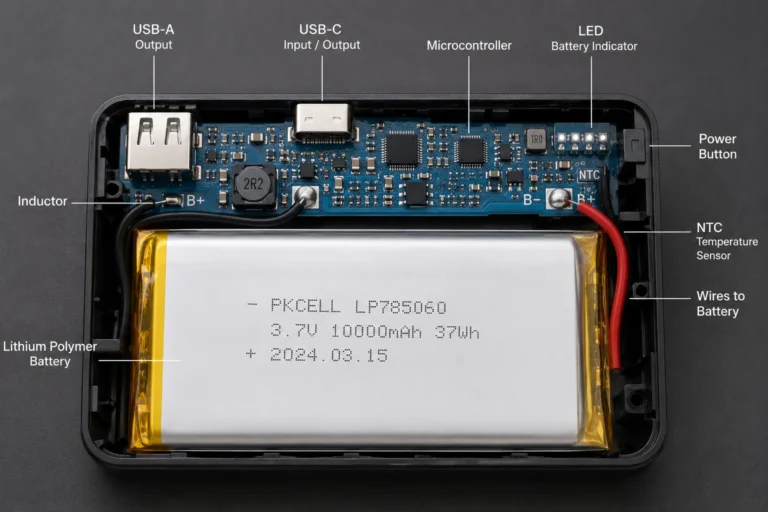
Americans buy millions of portable power banks and portable power stations every year. These devices offer convenient reassurance that you will not run out of power on the most important things in your pocket or bag. But portable power banks, especially cheap devices you buy on Amazon, pose a severe risk of fire that most consumers are unaware of.
Dangers of Portable Power Banks
Portable power banks use lithium-ion batteries. When lithium-ion batteries are defective or otherwise malfunction, they create a severe fire risk. Agencies like NFPA, OSHA, and the U.S. Fire Administration, a division of FEMA, have all published risk assessments and mitigation strategies.
One of the most significant risks is called thermal runaway. “Thermal runaway is a chain reaction where the heat released from the failure of one cell damages nearby cells.” The OSHA publication explains, “Because lithium-ion batteries combine a flammable electrolyte with a significant amount of stored energy, thermal runaway reactions are possible.” The most significant danger of thermal runaway is fire.
Thermal runaway fires are often more dangerous than ordinary fires for several reasons. First, as Clemson researchers observe, during thermal runaway the temperature of the battery can rise from 212 degrees Fahrenheit to 1,800 degrees in just one second. Everyone has heard the phrase, “where there’s smoke, there’s fire.” A thermal runaway fire does not build slowly and produce smoke as a warning. It burns extremely hot and fast.
Second, traditional fire suppression methods fail to control battery fires. Heard the instruction, “stop, drop, and roll”? That type of smothering of the fire does not work. Fire extinguishers and water often do not work. A battery is its own fuel source and sustains the fire on its own. Clemson researchers point out, for example: “Typically, an EV fire burns at roughly 5,000 degrees Fahrenheit (2,760 Celsius), while a gasoline-powered vehicle on fire burns at 1,500 F (815 C). It takes about 2,000 gallons of water to extinguish a burning gasoline-powered vehicle; putting out an EV fire can take 10 times more.”
What Causes Power Bank Burn Injuries?
According to OSHA, thermal runaway “can be initiated by internal short circuiting due to defects during manufacturing, mechanical damage to the battery, exposure to excessive heat or cold, and improper charging.” Manufacturing defects, fragile materials, and poor design can lead to ineffective separation of battery components and short circuits on important safety features like overcharge protection.
Power banks are required to meet certain safety standards like UL 2056 and UN 38.3. However, even if the design of a power bank technically meets those requirements, that does not mean it was assembled properly at the manufacturing plant or used effective materials, which can lead to fire from ordinary use of the device.
Another reason consumers are badly injured by lithium-ion batteries is that they are not properly warned about how to prevent damage to the power bank and the associated risk of fire. We are all used to being able to drop our phones, put them on a charger all night long, take them underwater, and leave them in the summer sun. Most consumers see a portable power bank in a hard case and do not realize it may be fragile and cheaply built underneath. They are not effectively warned of how to properly use and maintain the power bank and are not warned that lithium-ion battery fires are far more dangerous than ordinary fires.
What Should I Do If I Was Injured by a Lithium-Ion/Portable Power Bank Fire?
The first and most important task it to keep all parts of the battery or power bank in the same condition after the fire. If possible, maintain the clothing you were wearing and anything else damaged by the fire. While it may seem obvious what happened, you may be asked for these materials later.
You should also photograph your injuries. Burn injuries go through several stages of healing and often look completely different as time passes. It is important to document how your injuries progress.
Burn recovery outside the hospital often involves a painful daily routine. While the hospital documents your treatment while you are there, it is important to keep track of what you had to do–or could not do–outside the hospital due to your injuries.
Who Is Responsible for My Portable Power Bank Fire Injuries?
If your injuries were caused by manufacturing or design defects, or insufficient warnings, the product manufacturer is usually liable for your injuries. If different from the actual manufacturer, the company behind the brand name of the product is also usually liable. For example, brands that sell consumer goods may go to a Chinese manufacturer and decide which already-made products to brand and sell as their own.
Frequently, the actual manufacturer is in China, India, or another country where it is difficult to serve them with a lawsuit or have jurisdiction over them in court in the United States. In Washington State, when you cannot recover from the manufacturer the “product seller” becomes liable and must “stand in the shoes of” the manufacturer.
The product seller could be–and frequently is–an online retailer like Amazon. It could be big box retail like Target, Walmart, or Home Depot. It may also be a more local retailer.
Is Amazon Responsible for Portable Power Bank Fire Injuries?
In many cases Amazon is responsible dangerous and defective products sold on its site. Amazon sells a huge volume of portable power banks and other lithium-ion battery products and mandates certain safety requirements for portable power. But that does not mean those products are well-designed or well-manufactured.
To the contrary, through Amazon, fledgling and often foreign companies with little to no track record for safety can achieve mass distribution in U.S. markets almost overnight. This has resulted in numerous recalls of products sold substantially or exclusively on Amazon.
Stritmatter Law has handled numerous battery, fire, explosion, and similar cases against Amazon and others. If you have been injured, contact us for a free consultation.