

Partner
When we think about a defective vehicle causing an accident, we might picture brakes that fail, a tire that blows out, or a steering system that suddenly stops working.
But there is another type of vehicle defect that is just as important—a defect that makes the injuries from a crash much worse than they otherwise would have been.
That is the idea behind the legal concept of “crashworthiness.” And under Washington law, vehicle manufacturers have a responsibility to design and manufacture vehicles that, when a crash happens, provide reasonable protection to its occupants.
Cars Are Expected to Crash and Must Be Designed With that Expectation in Mind
No one buys a car intending to get into an accident. But manufacturers know that over the lifetime of millions of vehicles, crashes are inevitable.
That reality is important.
For many years, courts focused primarily on whether a defect in a vehicle caused an accident. But over time, courts recognized that this approach overlooked an important part of vehicle safety: what happens to the people inside the vehicle after the collision begins.
In 1968, the influential Eighth Circuit Court of Appeals case Larsen v. General Motors Corp. recognized that manufacturers should design vehicles with foreseeable collisions in mind. And in 1973, the Washington’s Supreme Court adopted that principle in Baumgardner v. American Motors Corp.
The requirement of crashworthiness has since been codified in Washington’s Pattern Jury Instructions: A manufacturer of a product (i.e. a vehicle or the relevant component of the vehicle) has a duty to design and/or manufacture the product to be crashworthy, that is, the product must be reasonably safe in reasonably foreseeable accidents or collisions.
In simple terms, a manufacturer can’t merely say, “Our vehicle didn’t cause the crash.” The next question that must be answered is: Did the design or construction of the vehicle/product make the crash more dangerous than it needed to be?
An “Enhanced Injury” Is Where The Harm Goes Over and Above What Would Have Happened Without the Defect
Crashworthiness cases involve what is called an enhanced injury.
Imagine that two vehicles collide. The collision itself might reasonably be expected to cause some injuries. But suppose a defective seat collapses during impact, an occupant compartment crushes unnecessarily, or a defect causes a fire after the collision. If that defect causes injuries beyond those that would otherwise have resulted from the crash, those additional injuries are enhanced injuries.
That distinction is what was recognized in the Baumgardner case. That case involved a front seat that broke loose during a collision and was propelled forward. The Washington Supreme Court recognized that there was no sound reason to protect a manufacturer from responsibility merely because its defective product aggravated injuries rather than causing the initial accident.
One useful way to understand crashworthiness is to think of it as a “second accident.” The “first accident” is the whatever caused the crash in the first place, such as a person’s negligent driving. The “second accident” is whatever caused the enhanced injuries.
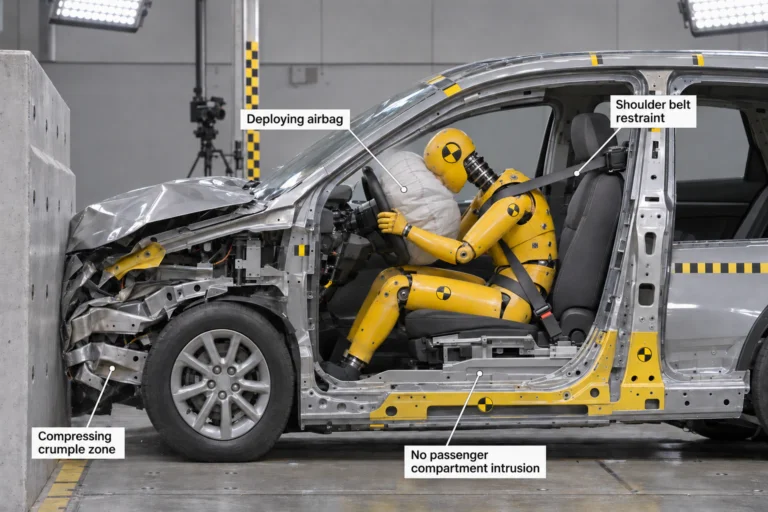
Modern vehicle safety systems are largely designed around controlling and minimizing that “second accident.” Seatbelts, airbags, head restraints, seats, crumple zones, and the passenger compartment all play a role in managing crash forces and protecting occupants. And when those systems fail, that’s when enhanced injuries can happen. For example:
- A seat, seatback, or head rest that fails during impact
- A seatbelt that doesn’t latch properly
- An airbag that doesn’t deploy (or that deploys when it isn’t supposed to)
- Front and rear portions of the vehicle that don’t “crumple” properly, i.e. absorb the force of the impact rather than transfer it into the passenger compartment
- A passenger compartment that doesn’t maintain its structural integrity to protect its occupants
- A vehicle component that contributes to a post-collision fire
- Other design or manufacturing problems that cause injuries beyond those expected from the collision itself
A crashworthiness case asks whether those systems performed as safely as they reasonably should have.
Having said that, with the creation and increasing availability of crash avoidance technology, the potential for crashworthiness claims has expanded beyond the “second accident” into ways that the vehicle could have but failed to stop or mitigate the accident from happening. Features like:
- Forward collision warning
- Blind spot warning
- Lane departure warning
- Automatic emergency braking
The concept of enhanced injury is also codified in Washington’s Pattern Jury Instructions: A manufacturer of a product is liable for that portion of the damage or injury caused by the product design or manufacturing defect over and above the injury or damage that probably would have occurred as a result of a reasonably foreseeable accident or collision impact even without the product defect.
Crashworthiness Cases Can Be Complicated
Crashworthiness and enhanced-injury cases are complex and highly fact-specific. They require knowing not just why the crash happened but also how particular injuries happened.
That can involve detailed and complex analysis of several factors including crash reconstruction, vehicle design and construction, biomechanics, medicine, and other technical evidence.
It also generally requires being able to inspect the vehicles that were involved in the crash and analysis of their crash data, because without the vehicles, there are simply too many questions that cannot be answered.
A Crash Doesn’t End the Manufacturer’s Responsibility
Perhaps the simplest way to understand crashworthiness law is this: Vehicle manufacturers don’t have to make cars that prevent every injury in every accident. But they do have an obligation to make reasonably safe vehicles that account for the reality that accidents happen.
If you or a family member suffered catastrophic injuries in a vehicle collision and there are questions about whether the vehicle adequately protected its occupants, an attorney experienced in automotive product-liability cases can investigate whether the vehicle itself contributed to the injuries.