

Senior Partner
The danger of young children falling from upper-story apartment windows has been recognized for decades. The Consumer Product Safety Commission estimates that 25 children age 10 and younger die each year as a result of falls from windows. The King County Department of Public Health estimates that nationwide, almost 5,000 children are treated in hospital emergency rooms every year for window fall-related injuries, with 30-50 children being treated at Harborview every year after falls from windows.

A three-year-old child fell from a fourth-story sliding window at an apartment complex like this in July 2004.
New York City adopted a law requiring fall-prevention guards on upper story apartment buildings occupied by young children in 1976.
There was widespread publicity about the danger of children falling from windows after musician Eric Clapton’s four-year-old son fell from an upper-story apartment window in 1991, inspiring the song “Tears in Heaven.”
Window safety and fall prevention devices
In 2000, and again in 2008, the Consumer Product Safety Commission issued guidance on the use of window guards and stops (which prevent windows from being opened more than four inches) to prevent children from falling from windows. The CPSC recommended that fall prevention devices be installed on windows in children’s bedrooms and other rooms where young children spend time. The CPSC also recommends keeping furniture (such as beds) away from windows to discourage children from climbing near windows.
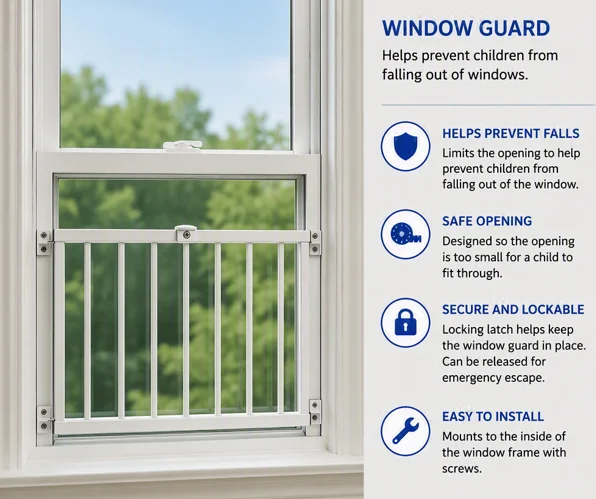
Illustration of a window guard
Child window falls can be easily prevented by the use of window stops that restrict a window from opening more than four inches. Window stops are inexpensive and readily available online or at hardware stores. Window stops comply with bedroom window egress requirements for fire safety and in fact are required by both the International Building Code and the International Fire Code for windows with a sill height of 36 inches or less from the floor. Window stops are designed to be difficult for young children to operate, but removable by adults if needed.
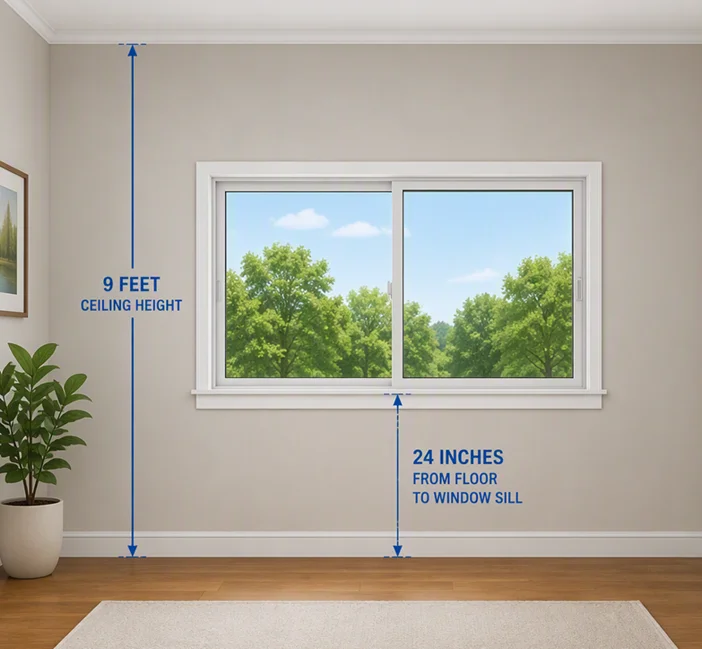
Illustration of window sill height that does not comply with the International Building Code and International Fire Code without a window stop to limit how far the window can be opened
Newer buildings have window fall prevention devices built into the windows because they are required by code. But older buildings must be retrofitted with fall prevention devices. Despite the fact that window fall prevention devices are inexpensive and easy to install, some property owners and property managers fail to install them, putting young children at risk of serious injury or death due to falling from a window. Most recently, in July 2026, a four-year-old girl was critically injured after falling from a sixth-floor apartment window in South Seattle.
The Central Pierce Fire Department provides recommendations for window fall prevention on their website, which tells the story of a young girl, the daughter of a firefighter, who fell from her bedroom window in 2023: https://www.centralpiercefire.org/window-falls/
Is my landlord liable if my child falls out of an apartment building window?
Property owners and managers of apartment buildings, and in some cases window manufacturers, can be held responsible for injuries to children who fall out of upper-story windows that lack fall prevention devices. The Washington Supreme Court adopted the implied warranty of habitability in Gerlach v. Cove Apartments, LLC, 196 Wn.2d 111 (2020). Under the implied warranty of habitability, landlords are subject to liability for injuries to tenants and others on a leased property with the consent of the tenant when the injury is caused by a dangerous condition that the landlord knew or should have been aware of and failed to exercise reasonable care to repair.
Stritmatter Law’s attorneys are experienced in handling cases involving child window falls in the State of Washington and available for a free consultation.