


Senior Partner
On May 15, 2026, three law firms filed a nationwide class action lawsuit against Amazon for bait and switch tactics in its “Subscribe & Save” program. Herman v. Amazon.com, Inc. alleges that Amazon entices consumers with artificial “subscription discount” prices only to then dramatically increase the price for future shipments—often above market prices on Amazon.
Amazon Subscribe & Switch
Amazon touts its “Subscribe & Save” program as a subscription discount—consumers save up to 15% off the single purchase price by enrolling in recurring purchases. If you know you’re going to buy the product again anyway, it makes sense to get a subscription discount, right? Why not “subscribe and save”?
The nationwide class action lawsuit, brought in federal court for the Western District of Washington, alleges that this discount is not what it seems. Amazon “outbids” third-party sellers on its site for the lowest price point to get consumers to sign up for “Subscribe & Save.” But the price Amazon offers is artificially low to induce consumers to subscribe.
Then Amazon jacks the prices up on subsequent orders, often by more than 15% (the original discount), and often to prices higher than those offered by other sellers. Sometimes the recurring order price in the “Subscribe & Save” program is above the price offered by the same seller at the same time. In other words, Amazon gets consumers to cede the opportunity to shop for better prices–by telling them they’re paying less than one-time purchase prices–and then charges more than competing one-time purchase prices on subsequent orders.
Predatory Subscription Class Action
Subscriptions are potent consumer traps because of their effect on consumer behavior. Inertia and psychological biases keep consumers in subscriptions even when a purely rational cost-benefit analysis would lead them to behave otherwise.
Regulatory agencies like the Federal Trade Commission (FTC) and Consumer Financial Protection Bureau (CFPB) have acted and published papers about “dark patterns and other tricks” of consumer subscription models. The FTC published a policy statement applying federal consumer law and the Restore Online Shoppers’ Confidence Act (ROSCA), which requires prominent disclosures about subscriptions.
Companies offering subscriptions must “clearly and conspicuously” disclose all the important terms of the subscription, including the amounts they will charge the consumer. The subscription also may not be overly difficult to withdraw from.
On September 25, 2025, the FTC announced a “historic” $2.5 billion settlement against Amazon, explaining that “Amazon used deceptive methods to sign up consumers for Prime subscriptions and made it exceedingly difficult to cancel.” The class action filed today involves some of the same consumer protection standards and practices by Amazon.
The Price is Right (Fixed)
Amazon famously started with the Bezos “flywheel,” a cycle where more customers would attract more sellers, leading to greater selection, and then to more customers again. In theory, the cycle has the additional benefit of lowering prices through competition and a lower (online) cost structure.
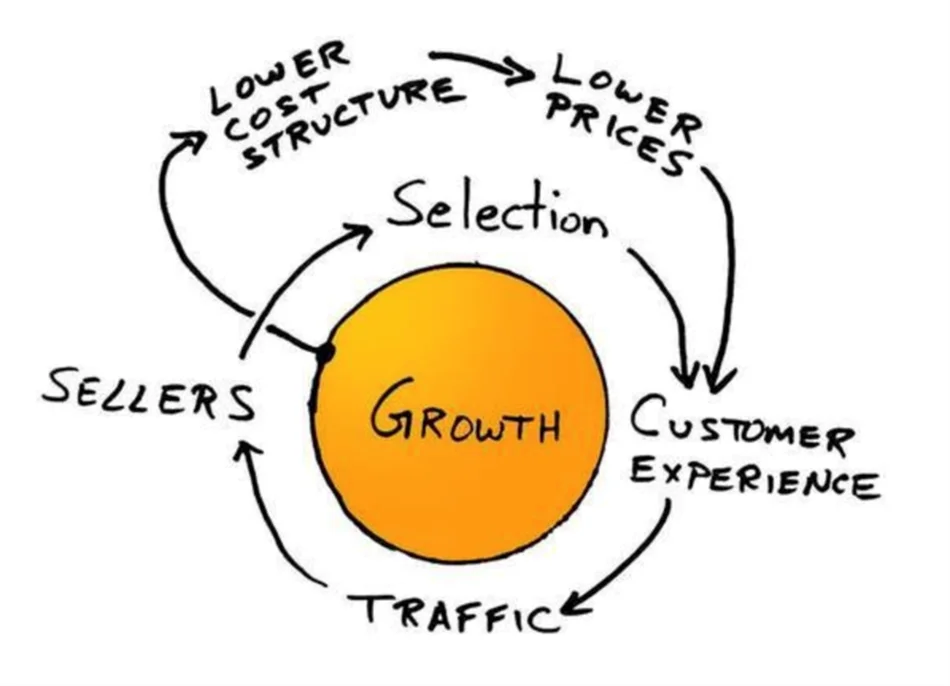
Now, the “Growth” circle has snowballed to over 100 million Amazon Prime members in the United States alone, with many millions more U.S. customers on Amazon without a Prime membership. Because Amazon has caught so many customers in its “flywheel,” for many businesses, saying “no” to Amazon is not an option.
Amazon has long been under fire for anticompetitive practices it uses to dictate prices. The FTC sued Amazon in 2023 alleging the company prevents third-party sellers from lowering prices and stifles fair competition. The FTC pointed to how Amazon prohibits sellers from offering lower prices at other stores than they do on the Amazon store. The company also allegedly conditions “Prime” eligibility, a “virtual necessity” for sellers, on sellers using the costly distribution service “Fulfillment by Amazon.” This “has made it substantially more expensive for sellers on Amazon to also offer their products on other platforms.” In other words, Amazon uses its leverage to gain more control over the market.
On April 20, 2026, California’s Attorney General announced the release of evidence “clearly showing Amazon’s illegal price fixing scheme that is artificially driving up prices for Americans.” According to filings, Amazon systematically leverages its vendors to increase retail prices on competitors’ websites: “This price fixing scheme typically begins with Amazon demanding that vendors ‘fix,’ ‘correct,’ ‘increase,’ ‘raise,’ or ‘look into’ the prices of products on other retailers’ websites.”
The term “flywheel” is apt—though not as Amazon portrays. A flywheel is a heavy wheel that moderates machines through inertia and retains energy. It is a mechanism not to foster variability and competition, but to regulate and control through sheer physical force—and then keep what is left over.
That is precisely what Amazon does in its “Subscribe & Save” program, this lawsuit alleges. The company induces consumers to rely on Amazon and avoid competing sellers and competing offers, which advances Amazon’s control over prices.
Seattle class action attorney Andrew Ackley explains: “This is about control. By offering artificially low prices on initial purchases, Amazon induces people to part with the most important feature in a free market—choice. Then the real price of ‘Subscribe & Switch’ comes due.”
The lawsuit, Herman v. Amazon.com, Inc., was filed by Stritmatter Law in Seattle, Levin Sedran & Berman LLP in Philadelphia, and Robert Pierce & Associates, P.C.in Pittsburgh.
You can view the complaint below.