

Senior Managing Partner
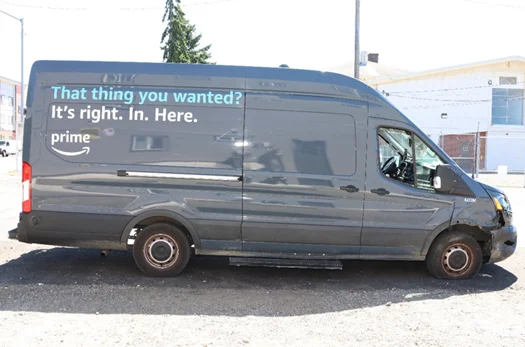
If an Amazon delivery driver hits you, more than one party can be responsible for paying for your injuries. The driver is responsible for driving carelessly. The delivery company that employs the driver can also be responsible, because Washington law makes employers pay for accidents their employees cause while doing their jobs. Amazon itself can be responsible if it controlled the driver’s work closely enough for the law to treat it like the employer. This matters because every insurance policy has a limit, and a serious injury can cost more than one policy pays. A Washington Amazon delivery accident attorney can find every responsible party before an insurance adjuster decides the case for you.
How Amazon’s Delivery Network Is Structured
Most packages that arrive in an Amazon van are not handed over by an Amazon employee. Amazon contracts with Delivery Service Partners, separate businesses that hire and pay the drivers, and it also runs Flex, a program in which people deliver in personal vehicles. On paper, those drivers work for someone other than Amazon.
That structure is the reason the liability question is contested at all. When a van runs a stop sign in a Seattle neighborhood, the delivery service partner is often a small company carrying a modest insurance policy. If your claims run past that policy, the gap between a claim against the contractor alone and a claim that also reaches Amazon is the gap between a partial result and a full one.
The practical picture of how these crashes tend to unfold on Seattle streets is consistent. The contracting paperwork says one thing, and the way the route actually ran says another.
Washington Looks at Control, Not the Contract Label
Washington courts do not treat the label in an agreement as the answer. They ask who held the right to control the physical conduct of the work, and courts have called that right to control the essential and often decisive factor. A company that hands another business a job and does nothing to control the work is generally not answerable for how that business performs it. A company that keeps a hand on the wheel is a different matter.
Washington courts have said that a business cannot declare a worker an independent contractor, keep control over the hazardous part of the undertaking, and then disclaim what goes wrong in that part. That reasoning runs through Massey v. Tube Art Display, a Washington Court of Appeals decision that arose from an excavation job rather than a delivery route, but that states the control test plainly.
Courts weigh a list of practical factors, and control is the one that carries the most weight:
- How much say the company has over the details of the work
- Whether the worker is engaged in a genuinely distinct occupation or business
- Who supplies the instrumentalities, the tools, and the place of work
- How the worker is paid, by the hour or by the job
- Whether the work is part of the regular business of the company
That is a partial list, and no single factor decides the question. What the parties called each other in their contract is one more item on it, not the answer. What matters most is the right to control the conduct from which the negligence flowed.
Vicarious Liability and Direct Negligence Are Separate Claims
Two different theories can reach a company, and they are not interchangeable.
Vicarious liability, also called respondeat superior, makes an employer answerable for what an employee does while acting on the employer’s behalf. The Washington Supreme Court stated the limit in Niece v. Elmview Group Home, a case about an employer’s responsibility for the intentional act of a staff member. When the employee steps aside from the employer’s purposes to pursue a personal objective, the employer is not vicariously liable.
Direct negligence is a separate road. In the same decision, the court explained that negligent hiring, retention, and supervision are analytically distinct and separate from vicarious liability, and that they survive even when the employee was acting outside the scope of employment. Here the claim is that the company itself was careless by putting a driver on the road it knew or should have known was dangerous, or building a route that made safe driving impractical.
That second road matters in delivery cases, because it does not require winning the employee versus contractor argument first. Either road runs on evidence that disappears quickly. Note the van number and the delivery company name shown on the vehicle, and talk to a lawyer before signing any release an insurer sends you.
Shared Fault and the Three-Year Deadline in Washington
Two rules shape almost every Washington claim of this kind.
The first is that partial fault does not end your case. If an insurer argues you were speeding or looking at your phone, Washington law reduces the award in proportion to your share of the fault and does not bar your recovery. Washington does not apply the fifty percent bar that many states use. There is a narrow statutory exception that matters in crash cases. A person who was under the influence, whose condition was a proximate cause of the harm, and who is found more than half at fault can be barred entirely. That is one more reason to have the facts reviewed rather than assumed.
The second is timing. Washington generally gives you three years to bring a negligencen action for an injury to a person, measured from the time the claim arises. Three years sounds like a long time. It is not, once you account for the time it takes to identify the right corporate defendants, obtain the contracts between Amazon and the delivery company, and preserve vehicle telematics/EDR before the data is overwritten.
Talk to Stritmatter Law About an Amazon Delivery Claim
Stritmatter Law has been trying cases in Washington since 1945, and the firm has taken Amazon on before. If an Amazon delivery vehicle injured you or damaged your property anywhere in the state, we can work to identify every party that shares responsibility and to preserve the evidence that proves it. Contact Stritmatter Law for a free consultation.