

Partner
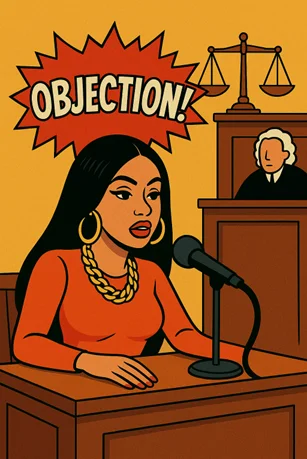
Has everyone been watching the Cardi B v. Emani Ellis trial? Every day, there’s been an entertaining new viral clip. Cardi B. and Ellis met in 2018 in the hallway of a medical office where Ellis was employed. Cardi B, pregnant at the time, was on her way to see her obstetrician and claims that Ellis took out her phone and started recording her. The incident devolved into at least a yelling match. Ellis filed a $24 million suit for assault and battery. Cardi B maintains that while they had a heated verbal argument, there was no physical contact.
Yesterday, the jury deliberated for less than an hour before finding Cardi B not liable. Not surprising, given the spectacle. Beyond the entertainment, the case provides a real-world checklist of mistakes plaintiffs’ lawyers should avoid. Here’s how things went wrong in court—and the lessons we can take away.
Educate Yourself
- What happened: During cross-examination, the plaintiff’s lawyer stumbled badly when Cardi appeared in court wearing a different wig. He asked, “Yesterday you had black hair, short hair. Today it’s blonde and long. Which one is your real hair? Or are they both real?” Rosen Janfaza said.
Cardi rolled her eyes, laughed, and said, “They’re wigs!” before Rosen Janfaza responded, “Sorry, I didn’t know that. It’s a good wig today, and then.”
The exchange immediately went viral, spawning headlines and memes. - Why it matters: The lawyer came off as uninformed and unprepared. He was completely unaware that wigs are a common aspect of Cardi’s style and culture.
- Lesson: Don’t let your questioning make you the punchline. If you appear clueless, the jury won’t just question you – they’ll question the strength of your client’s entire case.
Make Sure Each Question Has a Purpose
- What happened: The lawyer’s cross-examination quickly went off the rails. He asked about Cardi’s wigs. He asked how long it took her nails to grow three inches. He even asked if she was “disabled” at the time of the altercation, prompting Cardi to snap back, “When you’re pregnant, I’m very disabled… You want me to tell you things I can’t do?
It didn’t stop there. The lawyer also asked Cardi to repeat in court the exact words she admitted saying to Ellis – “I said b****h get the f*** out my face.” Cardi looked confused, and the judge then sustained her lawyer’s objection, shutting the question down. - Why it matters: None of these questions moved the ball forward. They wasted time, distracted the jury, and made the lawyer look out of touch. Whether Cardi’s hair was real, or how fast her nails grew, or whether she could repeat a curse word on cue had zero bearing on the case.
- Lesson: Every question must serve a purpose. If it doesn’t establish the defendant’s liability or your client’s damages, leave it out. Otherwise, you risk turning your cross into comedy and your case into a joke.
Don’t Neglect Anticipating Viral Testimony
- What happened: Building on the earlier missteps, the lawyer asked Cardi, “How do you know she wants your money?” Cardi’s instant comeback – “Because she sued me for $24 million dollars” landed like a mic drop.
- Why it matters: In one sentence, the narrative flipped. The plaintiff suddenly looked greedy and opportunistic, while Cardi appeared sharp, composed, and credible. That viral moment undercut the plaintiff’s entire framing of the case.
- Lesson: Never hand your opponent the chance to score a soundbite. Anticipate viral moments, prepare for them, and make a single one-longer doesn’t derail your client’s claim.
Don’t Underestimate the Power of Cross-Examination
- What happened: Defense attorneys highlighted inconsistencies in Ellis’s account, questioning when and how the alleged injury happened. They also hammered the point that Cardi B was acting in self-defense.
- Why it matters: The defense shifted the jury’s focus from “Did Cardi B injure Ellis?” to “Was Cardi B just protecting herself?”
- Lesson: Plaintiffs’ lawyers need to shore up their client’s story in advance. If inconsistencies exist, address them head-on before the defense makes them the centerpiece of trial.
Don’t Forget Emotional Storytelling
- What happened: Ellis testified that she lost her job and needed cosmetic surgery due to the scarring. But those details were drowned out by the flashier viral courtroom clips of Cardi B’s antics.
- Why it matters: Jurors and the public never got a clear, lasting emotional picture of Ellis as a victim.
- Lesson: Emotional damages can’t just be part of the testimony—they must be the through-line of the case. If the jury remembers the defendant’s jokes more than your client’s pain, you’ve lost ground.
Don’t Let the Defense Dictate Context
- What happened: Cardi B’s lawyers emphasized her pregnancy and fear, casting her as defensive rather than aggressive. They also pointed out contradictions in Ellis’s testimony.
- Why it matters: The defense framed Cardi B as a mother protecting her unborn child, which resonates powerfully with jurors.
- Lesson: Always anticipate the defense’s humanizing angle and come prepared with your client’s stronger, sympathetic story. Otherwise, the defendant’s framing dominates the courtroom.
Conclusion
The Cardi B trial illustrates how easily a plaintiff’s case can unravel when spectacle, inconsistent testimony, and viral moments overshadow the actual harm suffered. For plaintiffs’ personal injury lawyers, the big “don’ts” are clear:
- Don’t let theatrics eclipse injury.
- Don’t walk into court unprepared for viral soundbites.
- Don’t let emotional storytelling get lost in the noise.
At the end of the day, no matter how famous the defendant, the jury needs to leave the courtroom thinking not about what went viral—but about the real human suffering your client endured. Also, don’t file a minor assault case for $24 million dollars.